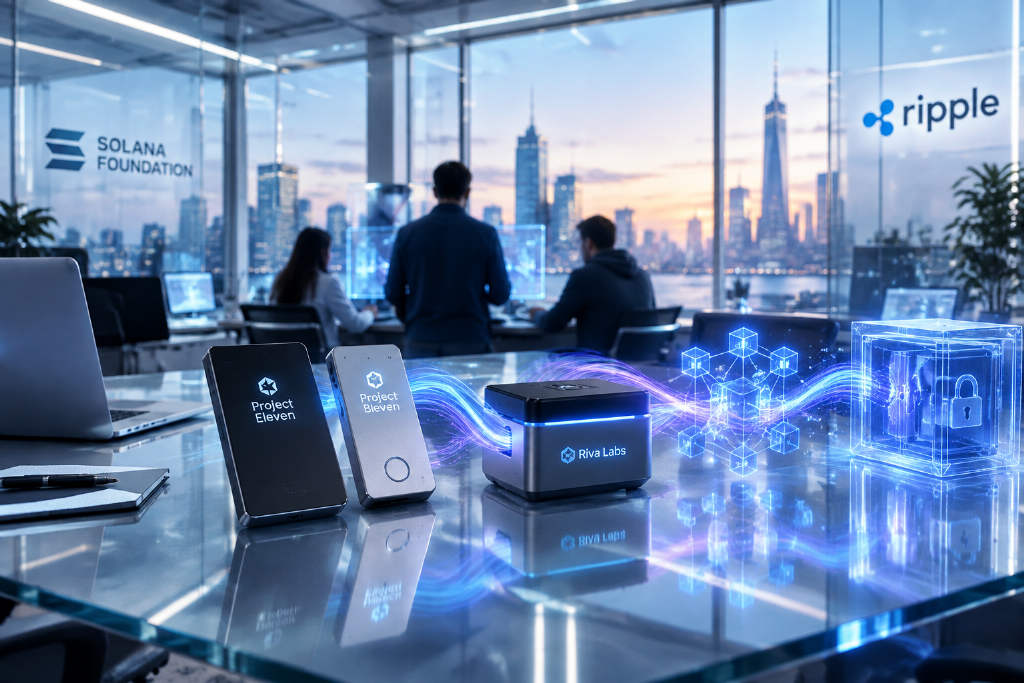
Project Eleve2026-09-29 15:44:57Project Eleven Buys Riva Labs to Add Post-Quantum Wallet and Signing TechnologyProject Eleven, a startup focused on preparing crypto networks for the arrival of powerful quantum computers, said it has acquired Riva Labs, a cryptography engineering team known for building post-quantum wallets and signing tools. The companies did not disclose the purchase price or any other deal terms. According to a statement shared with Unchained on Tuesday, Riva’s team, technology, and intellectual property will be folded into Project Eleven’s research and product efforts across digital asset custody, blockchain security, and post-quantum cryptography. Riva has centered much of its work on hash-based signatures, a class of signature schemes designed to resist attacks from quantum machines, and has applied that work to software wallets, hardware signers, multi-party computation setups on Ethereum and other public chains, and account abstraction. Project Eleven said the acquisition will help it approach migration as one integrated problem spanning signatures, wallets, key management, and protocol infrastructure. The company also pointed to AI as a force accelerating both cryptographic research and cryptanalysis. Project Eleven raised $20 million in a Series A round in January and has already worked with the Solana Foundation and Ripple on quantum-resistant testing and custody-related prototypes.170
bitcoin2026-07-23 13:10:14Bitcoin’s Post-Quantum Migration Harder Than Taproot, Must Start Now, Project Eleven CEO SaysProject Eleven CEO Alex Pruden said at Consensus Miami that Bitcoin's post-quantum migration is more complex than the Taproot upgrade and needs to begin immediately. Delay risks $2.3 trillion in assets; a quantum computer could steal funds in a single block if users haven't migrated.520
Solana2026-07-23 11:30:15Solana Quantum-Safety Test Cuts Network Speed by 90%Solana and Project Eleven found that post-quantum signatures pushed network speed down nearly 90% in April 2026 tests. Larger signatures and Solana’s public-key exposure have put both scalability and wallet security into sharper focus.1830
Bitcoin2026-07-22 10:08:14Researcher Wins 1 Bitcoin Bounty After Breaking 15-Bit Elliptic Curve Key on Quantum HardwareProject Eleven awarded 1 BTC to independent researcher Giancarlo Lelli for breaking a 15-bit elliptic curve key on publicly accessible quantum hardware, the largest public demonstration so far of this attack class.470
Bitcoin2026-07-22 02:16:19Bitcoin’s quantum problem may hit governance before quantum hardware arrivesA new zero-knowledge recovery tool from Project Eleven offers a possible escape route for some Bitcoin holders before practical quantum attacks become a reality, but it does not solve the hardest part of the problem. The tool works only for HD wallets created after 2012, leaving older coins in early pay-to-public-key, or P2PK, addresses outside its reach. That includes roughly 1.1 million BTC widely associated with Satoshi Nakamoto, spread across about 22,000 addresses. According to the article, the real debate is no longer just about when quantum computers will become capable of breaking elliptic-curve signatures. It is about what the Bitcoin community should do with legacy coins that cannot be migrated through modern cryptographic methods. Several paths are on the table, including doing nothing, freezing vulnerable coins under proposals such as BIP-361, throttling spending from old addresses, or even redistributing dormant coins through a hard fork. Each option cuts against a different part of Bitcoin’s value proposition, from property rights to immutability. The report also says markets are starting to price in this governance risk. It cites Jefferies’ decision in January 2026 to remove a 10% Bitcoin allocation from its pension model portfolio, not because a quantum breakthrough had already happened, but because of uncertainty over how Bitcoin would handle early vulnerable coins.1410
Bitcoin2026-07-19 10:00:00Bitcoin gets a quantum recovery tool, but it does not cover Satoshi’s 1.1 million BTCProject Eleven says it has funded a proof designed for a scenario in which quantum computers can forge Bitcoin signatures. Under that approach, a wallet’s own key-derivation path can be used as a stand-in for ownership, offering a recovery method if standard signatures are no longer reliable. The group said the proof runs in 243 milliseconds on a laptop, pointing to a lightweight implementation rather than a specialized hardware setup. The limitation is clear: the tool does not apply to Satoshi Nakamoto’s 1.1 million coins. That leaves one of the largest and most closely watched dormant Bitcoin holdings outside the scope of this recovery approach. The report was published by CoinDesk on July 19, 2026, in a piece written by Shaurya Malwa and edited by Aoyon Ashraf.1330
Project Eleve2026-07-16 19:01:54Project Eleven rolls out post-quantum proof concept for Bitcoin wallet ownershipSecurity firm Project Eleven has introduced a post-quantum proof technology designed for a scenario in which quantum computers can derive private keys and produce valid signatures, allowing users to prove ownership of Bitcoin wallets. According to the company, the method uses a wallet’s key derivation path so a user can demonstrate control without revealing the parent key, helping distinguish a legitimate owner from an attacker. Project Eleven CEO Alex Pruden described the approach in those terms. The prototype was developed with Jim Posen, a lead maintainer of the open-source Binius zero-knowledge proof system, and is based on the “signature lifting” technique proposed by Alon Sattath and Robert Wyborski. Project Eleven said the prototype has not been audited and would require blockchain protocol support before deployment. The company added that the design is mainly intended for users who, in the future, may miss a migration to quantum-resistant addresses.1330
Bitcoin2026-07-16 19:00:32Project Eleven proposes Bitcoin Q-Day recovery method to verify wallet ownership after quantum attacksProject Eleven has introduced a proposed Bitcoin recovery mechanism for a post-quantum scenario in which digital signatures can no longer reliably prove wallet ownership. The security firm argues that the real problem after “Q-Day” is not only that quantum computers may derive private keys from public keys, but that both attackers and legitimate holders could then produce equally valid signatures. Its answer is a derivation-based proof tied to a wallet’s key derivation path, allowing a user to prove control of the parent key used to generate a wallet’s private key without revealing that parent key itself. According to CEO Alex Pruden, that distinction would remain meaningful even if the address private key had already been compromised. The proposal was developed with Binius lead maintainer Jim Posen and builds on a method called “signature lifting,” first proposed by Alon Sattath and Robert Wyborski. The company frames the mechanism as a fallback for users who miss a future migration to quantum-safe addresses, at a time when work on Bitcoin’s post-quantum preparedness is moving ahead through BIP-360, BTQ Technologies’ testnet work, and warnings from Coinbase’s quantum advisory council.1530